Canottaggio
CANOTTAGGIO - ROWING
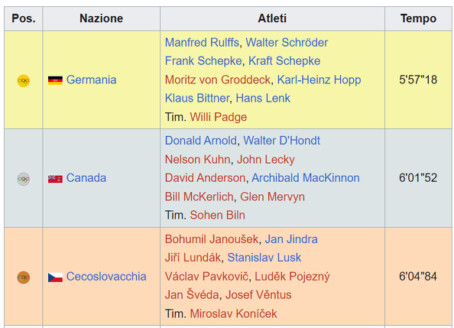
Nel 1960, a Roma, nel canottaggio, i più ispirati sembravano in dubbiamente i canottieri tedeschi, tanto che il loro allenatore, Karl Adam, era diventato una leggenda per il disegno innovativo delle barche, le astute tattiche di gara e i rigorosi metodi di allenamento, i suoi equipaggi quando manovrano alla perfezione, offrivano uno spettacolo bizzarro ma quasi ipnotico. Alla fine, su sette gare, tre furono dominate proprio dai tedeschi che chiusero il programma sul Lago di Albano con la spettacolare vittoria dell'Otto con, formato da Karl Hopp, Walter Schroder, Klaus Bittner, Kraft Schepke, Frank Schepke, Manfred Rulffs, Hans Lenk, Karl Von Groddeck e il piccolo timoniere Willi Padge.
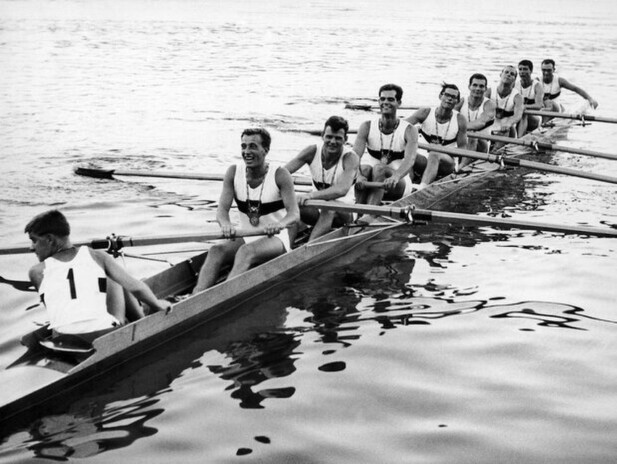
L'equipaggio della "otto con" vincitori della medaglia d'oro
The crew of the "Eight with the Helmsman" with the gold medal around their necks
The crew of the "Eight with the Helmsman" with the gold medal around their necks
In 1960, in Rome, in rowing, the most inspired seemed in doubt the German rowers, so much so that their coach, Karl Adam, had become a legend for the innovative design of the boats, the cunning racing tactics and the rigorous training methods, his crews when they manoeuvre to perfection, offered a bizarre but almost hypnotic spectacle. In the end, out of seven races, three were dominated by the Germans who closed the program on Lake Albano with the spectacular victory of the "Eights", made up of Karl Hopp, Walter Schroder, Klaus Bittner, Kraft Schepke, Frank Schepke, Manfred Rulffs, Hans Lenk, Karl Von Groddeck and the small helmsman Willi Padge.
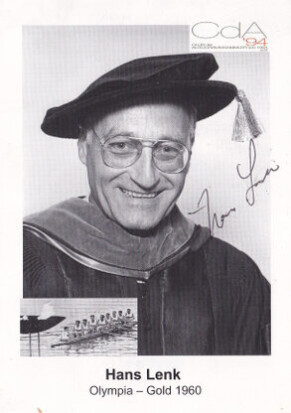
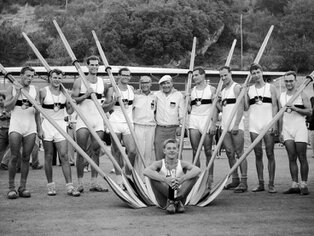
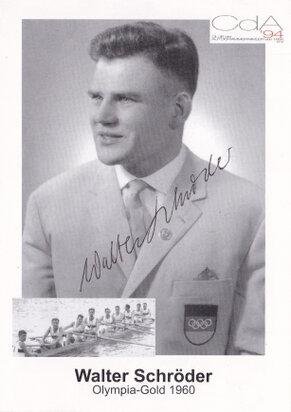
I campioni olimpici Manfred Rulffs, Walter Schröder, Frank Schepke, Kraft Schepke, Moritz von Groddeck, Karl-Heinz Hopp, Klaus Bittner, Hans Lenk,
Tim. Willi Padge e gli autografi di due di loro su cartolina
Tim. Willi Padge e gli autografi di due di loro su cartolina
Lo svolgimento della gara dell'Otto con ripeté fin nei particolari il quadro disegnato da Adam. Con le acque calme ed un leggero vento a favore, la Germania si portò ben presto in testa mentre il Canada era secondo. A metà percorso la Germania aveva un vantaggio di una lunghezza e mezzo rispetto al Canada, seguito da Francia e Cecoslovacchia. Al segnale dei 750 metri i canadesi provarono ad accelerare, come aveva previsto l'allenatore tedesco, riuscendo quasi a strappare la prima posizione all'armo della Germania, finche questi, che avevano atteso pazientemente quel momento, non scatenarono il loro furioso contrattacco con quarantacinque colpi al minuto, avventandosi sulla linea di arrivo con un vantaggio di quasi una barca e scendendo sotto il precedente record del mondo di 5 e 2".
The conduct of the "Eight" race repeats in detail the painting drawn by Adam. With calm waters and a light tailwind, Germany soon took the lead while Canada was second. At the halfway point, Germany had a one-and-a-half-length advantage over Canada, followed by France and Czechoslovakia. At the 750-meter mark, the Canadians attempted to accelerate, as the German coach had predicted, almost managing to snatch first place from the German army, until the latter, who had patiently waited for that moment, unleashed their furious counterattack with forty-five shots per minute, pounced on the finish line with an advantage of almost a boat and falling below the previous world record of 5 and 2".
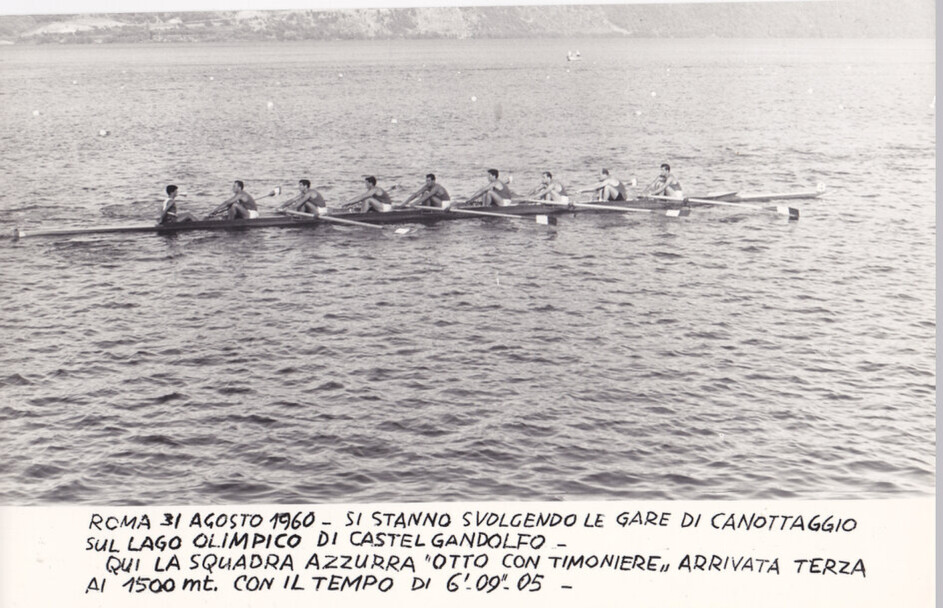

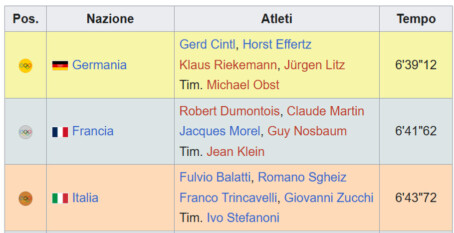
Ma la prima finale disputatasi il 3 settembre, nelle acque del lago di Abano, fu quella del "quattro con" che vedeva alla partenza gli equipaggi di Unione Sovietica, Ungheria, Italia, Germania, Francia e Australia. Il via fu dato alle 15.00 precise ed i sovietici, sperando di sorprendere i loro avversari, partirono a razzo e fino ai mille metri conducevano in testa la regata. Poi, con vogate micidiali, i tedeschi guadagnarono una punta sui sovietici che cercarono di resistere ma che furono definitivamente distanziati ai millecinquecento. I tedeschi chiusero la gara in 6'39"12, seguiti dai francesi, protagonisti di un bel recupero, terzi gli italiani che superarono gli stanchissimi sovietici nel rush finale.
But the first final held on September 3, in the waters of Lake Abano, was that of the "men's coxed four" which saw the crews of the Soviet Union, Hungary, Italy, Germany, France and Australia at the start. The start was given at 3.00 pm sharp and the Soviets, hoping to surprise their opponents, set off by rocket and led the race to the top of the hill. Then, in deadly rowings, the Germans gained a foothold over the Soviets who tried to resist but who were definitively distanced from the fifteen hundred. The Germans finished the race in 6'39"12, followed by the French, who made a good recovery, with the Italians third, overcoming the very tired Soviets in the final rush.
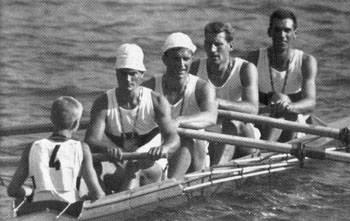
Gerd Cintl, Horst Effertz, Klaus Riekemann. Jürgen Litz. Tim. Michael Obst
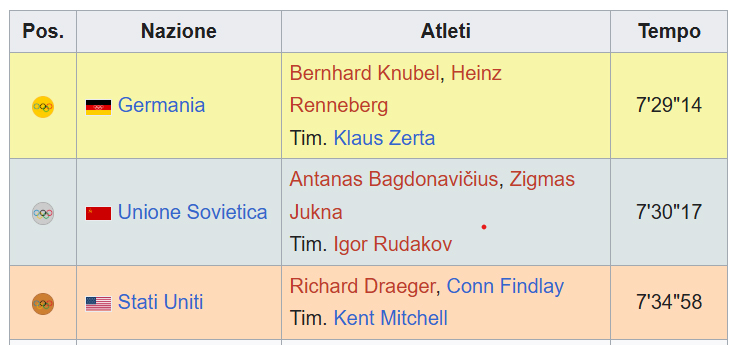
Nel "2 con" si pronosticava un'altra lotta tra sovietici e tedeschi. Alla partenza i l'armo tedesco, con l'esperto Heinz Rennenberg il gigante Bernhard Knubel ed il piccolo timoniere Klaus Zerta, partì in tromba. Ai primi rilevamenti i due armi favoriti passarono appaiati. Ai mille metri i tedeschi produssero lo sforzo massimo, con vogate lunghe e potenti. Ai 1500 avevano già mezza barca sui sovietici, mentre da dietro stava tornando impetuoso l'armo statunitense. Un ultimo, terribile sforzo ed i tedeschi riuscirono a conquistare la medaglia d'oro con il tempo di 7'29"13, seguiti dai sovietici e dagli americani che, pur crollando nel finale, riuscirono a mantenere un lievissimo vantaggio su danesi, italiani e romeni.
In the "In the "men's coxed pair" another fight between the Soviets and the Germans was predicted. At the start the German army, with the experienced Heinz Rennenberg the giant Bernhard Knubel and the small helmsman Klaus Zerta, set off on trumpet. At the first detections the two favored weapons passed in pairs. At the thousand meters the Germans produced the maximum effort, with long and powerful rowings. By the 1500s they already had half a boat on the Soviets, while the American army was rushing back from behind. A final, terrible effort and the Germans managed to win the gold medal with a time of 7'29"13, followed by the Soviets and the Americans who, despite collapsing towards the end, managed to maintain a very slight advantage over the Danes, Italians and Romanians.
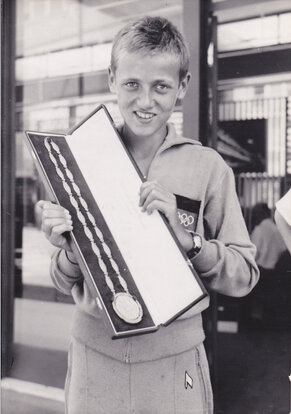
Il timoniere del "due con" Klaus Zerta con la sua medaglia d'oro

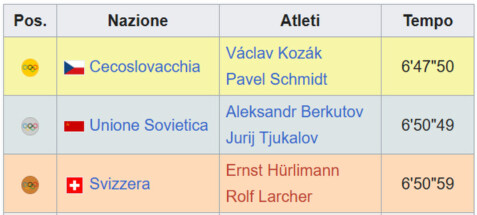
Le altre 4 medaglie in palio nel Canottaggio andarono agli statunitensi J. Sayre, R. Wailes, T. Nash e A. Ayrault nel "quattro senza", ai sovietici nel "due senza" e nel "singolo" ed ai cecoslovacchi nel "due di coppia".
The other four medals up for grabs in rowing went to Americans J. Sayre, R. Wailes, T. Nash and A. Ayrault in the "men's coxless fours", to the Soviets in the "men's coxless pair" and the "men's single sculls" and to the Czechoslovakians in the "men's double sculls".
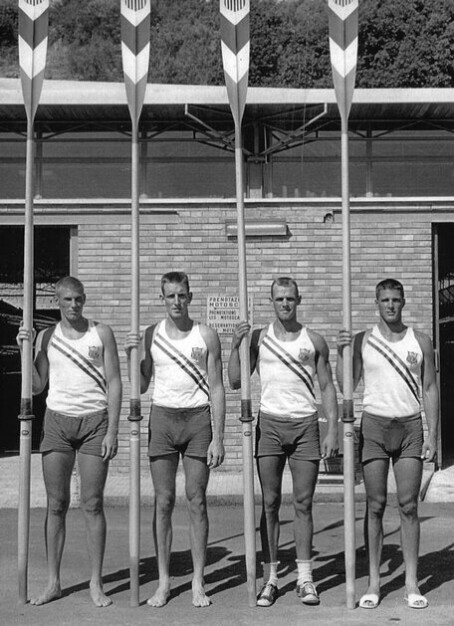
Gli americani Arthur Ayrault, Theodore Nash. John Sayre e Richard Wailes, vincitori della medaglia d'oro nel "4 senza"
The Americans Arthur Ayrault, Theodore Nash. John Sayre and Richard Wailes, gold medalists in the ""men's coxless fours""
The Americans Arthur Ayrault, Theodore Nash. John Sayre and Richard Wailes, gold medalists in the ""men's coxless fours""
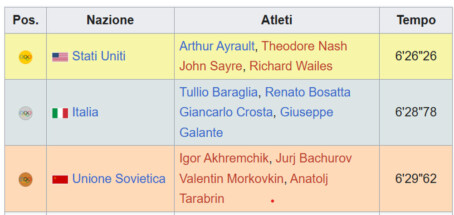
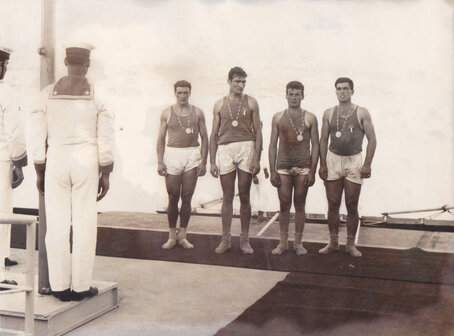
Gli Italiani Tullio Baraglia, Renato Bosatta, Giancarlo Crosta e Giuseppe Galante, vincitori della medaglia d'argento nel "4 senza"
Italians Tullio Baraglia, Renato Bosatta, Giancarlo Crosta and Giuseppe Galante, winners of the silver medal in the "men's coxless fours"
Italians Tullio Baraglia, Renato Bosatta, Giancarlo Crosta and Giuseppe Galante, winners of the silver medal in the "men's coxless fours"
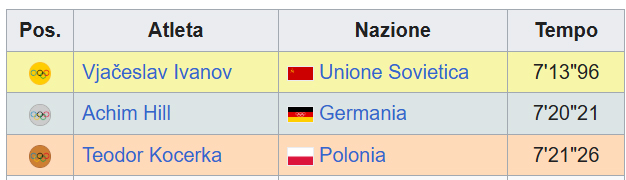
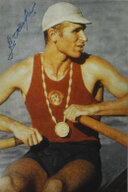
Il sovietico Vyacheslav Ivanov vincitore della medaglia d'oro nel "singolo" Soviet Vyacheslav Ivanov wins gold medal in "men's single sculls"
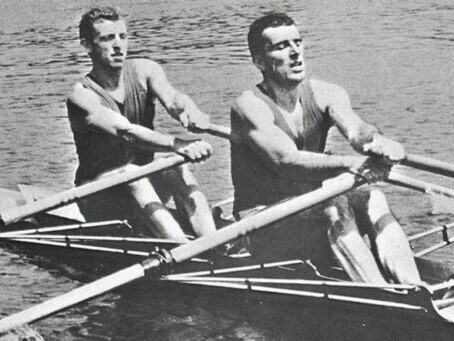
I Cecoslovacchi Václav Kozák e Pavel Schmidt vincitori della medaglia d'oro nel "due di coppia2
Czechoslovakians Václav Kozák and Pavel Schmidt won the gold medal in the "men's double sculls"
Czechoslovakians Václav Kozák and Pavel Schmidt won the gold medal in the "men's double sculls"
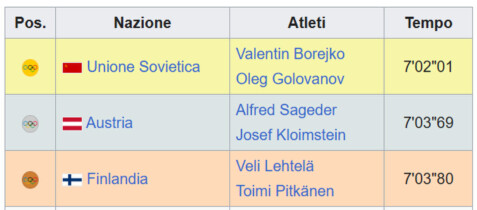
I sovietici Valentin Boreyko e and Oleg Golovanov vincitori della medaglia nella gara "Due di coppia"
Soviets Valentin Boreyko and Oleg Golovanov medal winners in the "men's coxless pair"
Soviets Valentin Boreyko and Oleg Golovanov medal winners in the "men's coxless pair"

