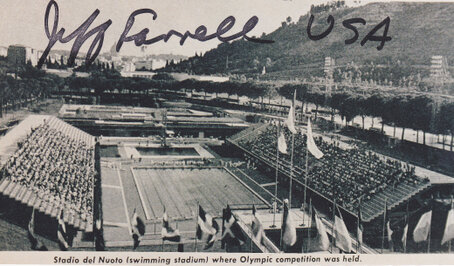
NUOTO 3
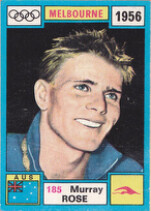
Il 31 agosto fu la giornata migliore per gli australiani che si aggiudicarono entrambi i titoli in palio quella sera: 400 stile libero uomini e 100 dorso uomini. La competizione dei 400 metri s.l. vide in gara 40 atleti, ma in finale arrivarono quelli che tutti consideravano i migliori in questa misura: i due australiani Konrads e Rose, gli americani Sommers e Black, i giapponesi Yamanaka e Fukui, il sudafricano McLachlan e il britannico Lenz, ma alla fine si rivelò una sfida a tre, tra i due "canguri" ed il giapponese Yamanaka. Prevalse Murray Rose con una tattica al quanto strana ma che si rivelò vincente: fece andare avanti per i primi 200 metri tutti i suoi più accreditati avversari, poi, quando sembrava oramai essere tagliato fuori dai giochi, con un'accelerazione impressionante, raggiunse e sorpassò sia Konrads che Yamanaka andando a vincere la sua seconda Olimpiade consecutiva con il tempo di 4'18"3, nuovo record olimpico. Dietro di lui il giapponese ed il connazionale Konrads.
August 31 was the best day for the Australians, who won both titles up for grabs that evening: the men’s 400 freestyle and the men’s 100 backstroke. The 400-meter freestyle event featured 40 competitors, but the finalists were the swimmers everyone considered the best in this distance: the two Australians, Konrads and Rose; the Americans, Sommers and Black; the Japanese, Yamanaka and Fukui; the South African, McLachlan; and the British swimmer, Lenz. In the end, however, it turned out to be a three-way battle between the two “kangaroos” and the Japanese swimmer Yamanaka. Murray Rose prevailed with a somewhat unusual tactic that proved successful: he let all his strongest rivals take the lead for the first 200 meters; then, just when it seemed he was out of contention, with an impressive burst of speed, he caught up to and passed both Konrads and Yamanaka, going on to win his second consecutive Olympic gold medal with a time of 4'18"3, a new Olympic record. Behind him were the Japanese swimmer and his compatriot Konrads
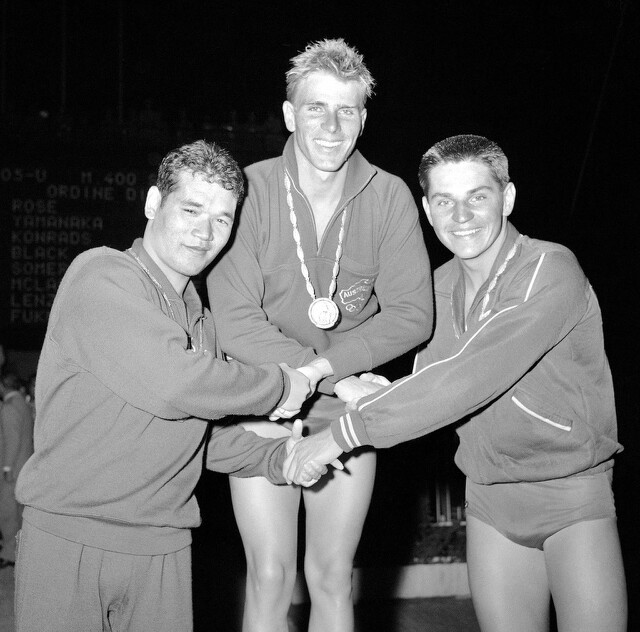
Il podio dei 400 metri stile libero
I 100 dorso maschile, al contrario dei 400 s.l., non fornirono particolari emozioni. Il netto favorito era David Theile, un ventiduenne australiano che, col suo metro e novanta, si ergeva su tutti gli altri 36 concorrenti. Theile vinse così come aveva vinto 4 anni prima a Melbourne, battendo lo stesso avversario del 1956, l'americano Frank McKinney. Bronzo all'altro americano Robert Bennet.
The men’s 100-meter backstroke, unlike the 400-meter freestyle, didn’t provide any particular thrills. The clear favorite was David Theile, a 22-year-old Australian who, at 1.90 meters tall, towered over all 36 of his competitors. Theile won just as he had four years earlier in Melbourne, defeating the same opponent he had faced in 1956, the American Frank McKinney. Bronze went to another American, Robert Bennett.
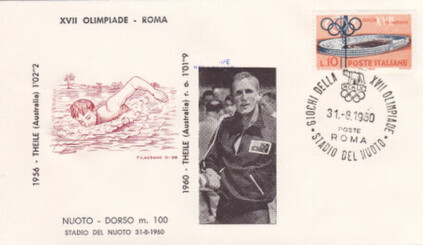
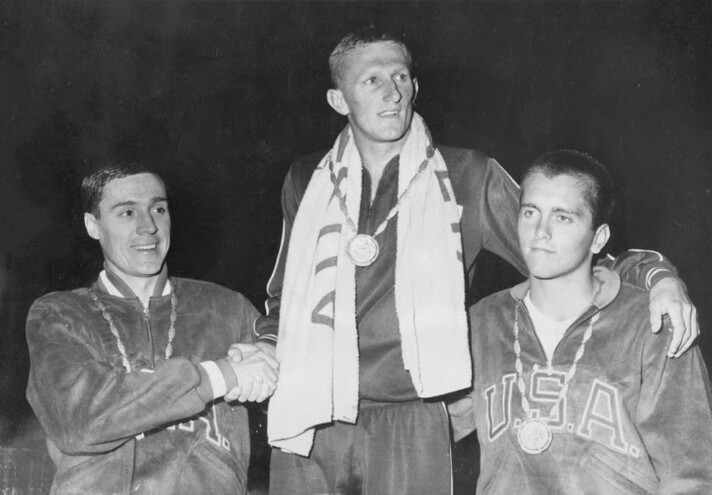
Il podio della gara dei 100 metri dorso maschili

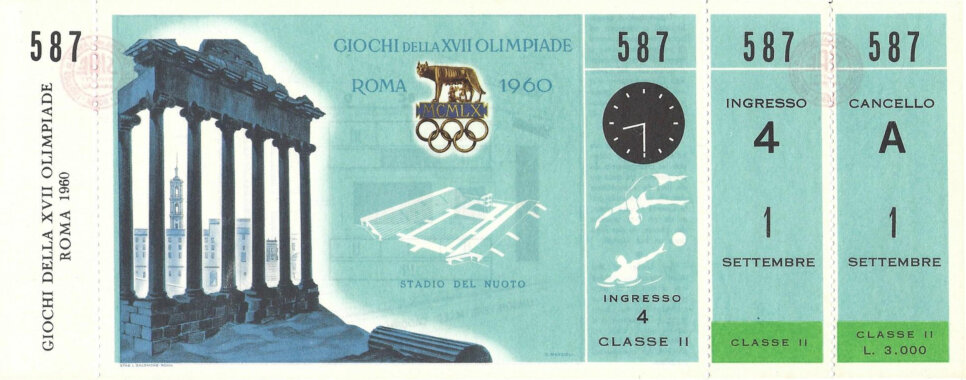
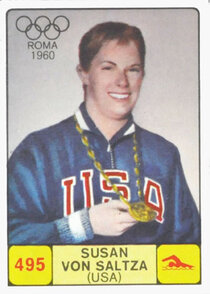
Il 1° settembre fu per i nuotatori americani il giorno più bello nello Stadio del Nuoto, la banda non fece altro che suonare "Star Spangled Banner" quella sera. Prima la sedicenne Chris Von Saltza (stella del Santa Clara Swim Club) che vinse i 400 metri stile libero in 4'50"6, frantumando il record olimpico e prendendosi una rivincita, dopo la sconfitta nei 100 stile libero del giorno precedente ad opera di Dawn Fraser.
September 1° was the most beautiful day for American swimmers at the Swimming Stadium, the band did nothing but play "Star Spangled Banner" that evening. First, sixteen-year-old Chris Von Saltza (star of the Santa Clara Swim Club) won the 400-meter freestyle in 4:50.6, shattering the Olympic record and taking revenge after Dawn Fraser's defeat in the 100-meter freestyle the previous day.
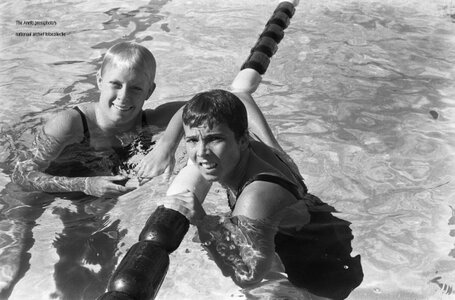
Chris von Saltza con la seconta arrivata, la svedese Jane Cederqvist
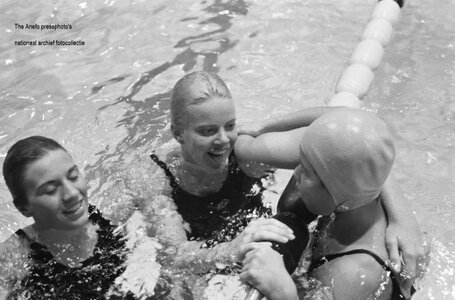
Le tre medagliate subito dopo l'arrivo
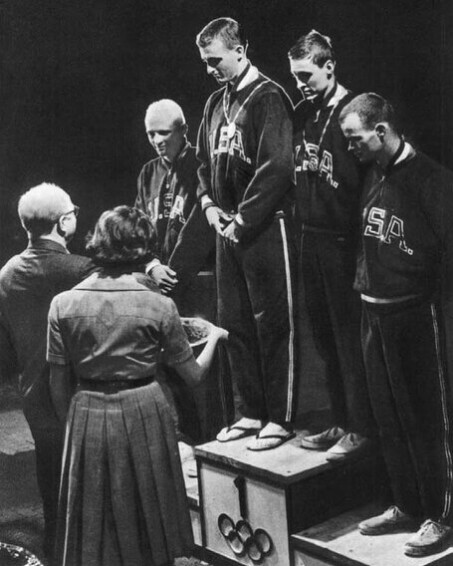
Gli uomini avevano vinto entrambe le staffette. Lance Larson, con una grande frazione di delfino nella staffetta mista, si era preso la medaglia d'oro di cui era stato defraudato nella finale dei cento stile libero e con i suoi compagni realizzò un eccezionale 4'05"4, demolendo il vecchio record del mondo e distaccando gli australiani (argento) ed i giapponesi (bronzo) di oltre 7 secondi. . Ancora più impressionante era stata la prestazione di Jeff Farrell che ebbe la forza di nuotare la sua doppia frazione di staffetta, nonostante nel programma la 4x100 mista e la 4x200 stile libero erano separati soltanto da un'ora e dieci minuti. Farrell, entrato in acqua in l'ultima frazione e quasi contemporaneamente con lo staffettista giapponese, con la sua bracciata lenta e pulita, concluse la sua fatica e quella dei suoi compagni Harrison, Blick e Troy, con due lunghezze di margine sul giapponese e due e mezza sull'australiano.
The men had won both relays. Lance Larson, with a superb butterfly leg in the medley relay, claimed the gold medal he had been denied in the 100-meter freestyle final, and together with his teammates, they posted an exceptional time of 4:05.4, shattering the old world record and finishing more than 7 seconds ahead of the Australians (silver) and the Japanese (bronze). Even more impressive was the performance of Jeff Farrell, who had the stamina to swim his two relay legs, even though the 4x100 mixed and the 4x200 freestyle relays were scheduled just one hour and ten minutes apart. Farrell, who entered the water for the final leg almost simultaneously with the Japanese relay swimmer, used his slow, clean stroke to cap off his own effort and that of his teammates Harrison, Blick, and Troy, finishing two lengths ahead of the Japanese swimmer and two and a half lengths ahead of the Australian.