Greco-Romana
LOTTA GRECO-ROMANA - GRECO-ROMAN WRESTLING
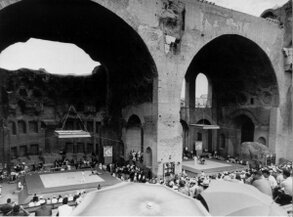
Furono 336 i lottatori di Greco-Romana e Libera a confrontarsi tra le maestose rovine della Basilica di Massenzio. Il primo torneo ad entrare in scena fu quello della Greco-Romana, disciplina popolare in Europa ed Asia. I pronostici erano tutti orientati per i sovietici, vincitori di cinque ori a Melbourne. Vediamo i risultati, categoria per categoria, dai più leggeri ai più pesanti.
A total of 336 Greco-Roman and freestyle wrestlers competed amid the majestic ruins of the Basilica of Maxentius. The first tournament to take place was the Greco-Roman event, a popular discipline in Europe and Asia. All predictions favored the Soviets, who had won five gold medals in Melbourne. Let’s look at the results, category by category, from the lightest to the heaviest weight classes.
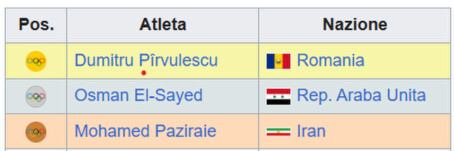
Nei pesi Mosca (18 concorrenti in gara), impressionarono lo stile del sovietico Ivan Kochergin e del giapponese Takashi Hirata oltre che dell'egiziano Ossan Sayed e dell'iraniano Mohammad Paziraye. Nella corsa al podio si inserirono anche l'italiano Ignazio Fabra e il romeno Dumitru Pirvulescu. E fu proprio quest'ultimo ad aggiudicarsi l'oro (primo oro olimpico per la Romania), grazie al computo dei punti negativi.
In the flyweight division (18 competitors), the style of the Soviet Ivan Kochergin and the Japanese Takashi Hirata, as well as that of the Egyptian Ossan Sayed and the Iranian Mohammad Paziraye, was impressive. Italy’s Ignazio Fabra and Romania’s Dumitru Pirvulescu also joined the race for the podium. It was Pirvulescu who ultimately won the gold medal (Romania’s first Olympic gold), thanks to the negative points system.
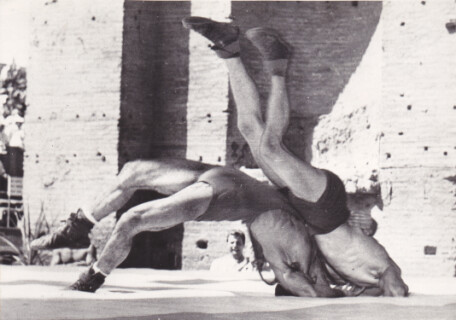
un incontro dell'italiano Fabra contro Nevis
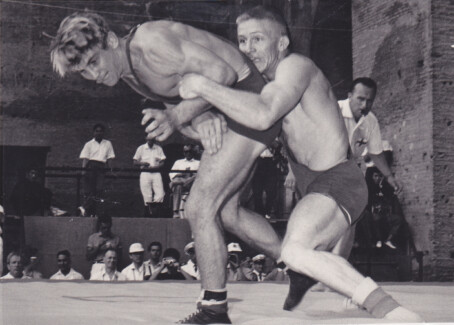
Wilson e Sinyaysky in azione
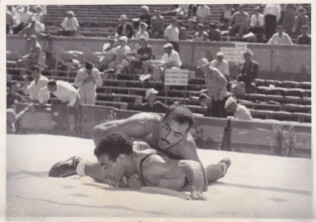
il match tra l'egiziano Sayed e l'iraniano Paziraye,
argento e bronzo in questa categoria
argento e bronzo in questa categoria
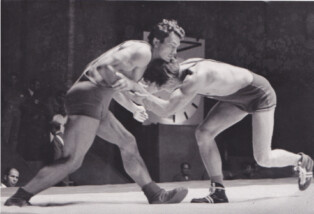
sopra e a destra il vincitore della medaglia d'oro,
il rumeno Pirvulescu in due differenti match
il rumeno Pirvulescu in due differenti match
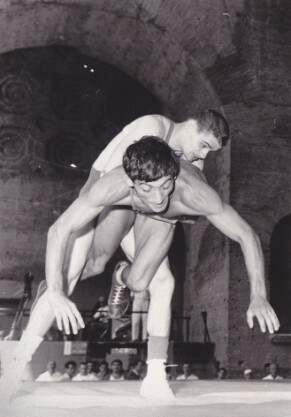
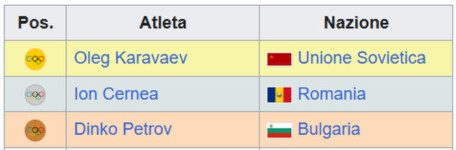
Nei pesi Gallo 21 atleti in gara. Il sovietico Karavaev doveva difendere il titolo del suo connazionale Virupajev ed in effetti dominò il torneo, iniziando con due vittorie prima del limite sul norvegese Tveiten e sul belga Verhoven. Poi dopo aver battuto anche lo jugoslavo Dora ed il libanese si trovò di fronte il giapponese Ichiguchi con il quale disputò uno dei migliori incontri della sua carriera finendo il giapponese con uno spettacolare atterramento per rovesciata. Argento e bronzo ai il romeno Cernea ed il bulgaro Stoykov.
In the Bantamweight division, 21 athletes competed. The Soviet Karavaev was set to defend the title held by his compatriot Virupajev, and he indeed dominated the tournament, starting with two first-round victories over the Norwegian Tveiten and the Belgian Verhoven. Then, after also defeating the Yugoslav Dora and the Lebanese fighter, he faced the Japanese fighter Ichiguchi, against whom he fought one of the best bouts of his career, finishing the Japanese fighter with a spectacular takedown using a reverse throw. Silver and bronze went to the Romanian Cernea and the Bulgarian Stoykov.
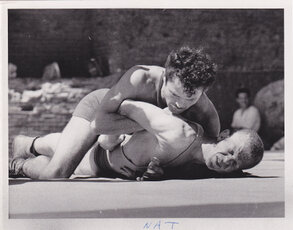
La medaglia d'oro Oleg Karavaev nel match contro il norvegese Tveiten
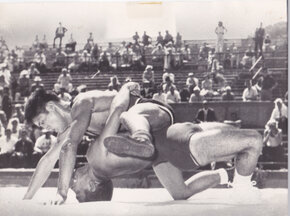
Il match tra il giapponese Ichiguchi e l'americano Lauchle
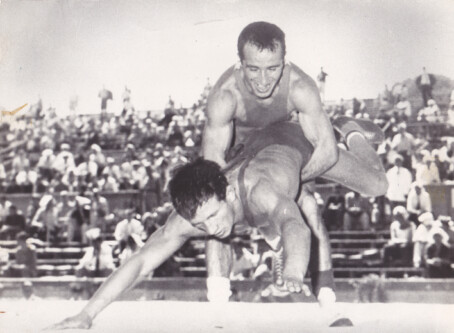
l'italiano Gramellini batte il polacco Knitter
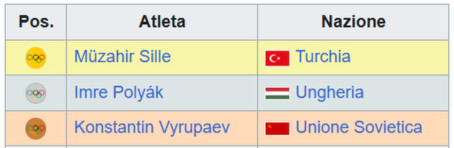
Nei pesi Piuma, con 25 atleti in gara, si registrò subito la sorpresa della sconfitta dell'olimpionico uscente, il finnico Makinen. ll torneo, grazie ad una serie di coincidenze e ad un grande match di finale, fu vinto dal turco ottomano Muzahir Sille che batté il vice campione olimpico di Melbourne, l'ungherese Imre Polyac.
In the featherweight division, with 25 athletes competing, the tournament began with a surprise defeat for the defending Olympic champion, the Finn Makinen. Thanks to a series of coincidences and a thrilling final match, the tournament was won by the Ottoman Turkish boxer Muzahir Sille, who defeated the Melbourne Olympic silver medalist, the Hungarian Imre Polyac.
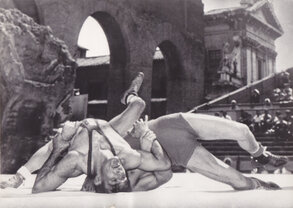
In queste due foto due incontri dell'italiano Umberto Trippa, contro il francese Roger Mannhard (a sinstra) e contro l'austriaco Hans Marte (a destra)
These two photos show two matches featuring the Italian Umberto Trippa: one against the Frenchman Roger Mannhard (on the left) and one against the Austrian Hans Marte (on the right).
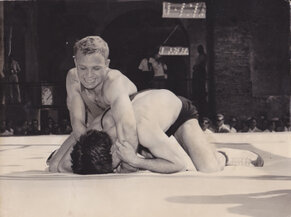
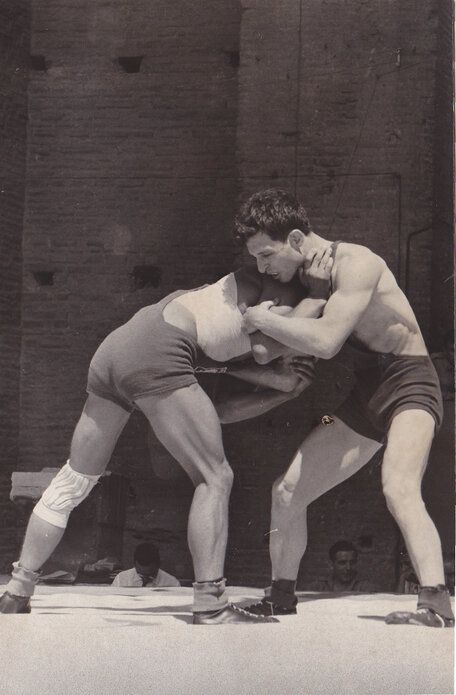
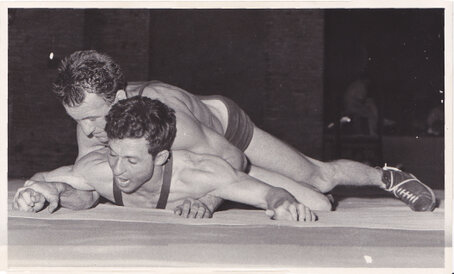
Nelle due foto sotto due incontri della medaglia doro Sille, contro il polacco Macioch e contro l'ungherese Polyak
The two photos below show two matches featuring gold medalist Sille, against Macioch of Poland and against Polyak of Hungary
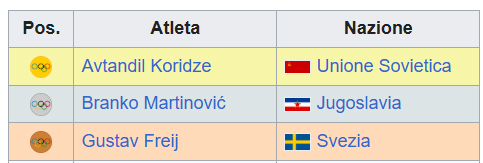
Tra i 23 lottatori del torneo riservato ai pesi Leggeri si evidenziava la presenza del campione olimpico di Melbourne, il finnico Kyosti Lethonen, favorito alla conquista dell'oro. Altri favoriti erano i bulgaro Dimitar Stoyanov e il campione olimpico di Londra 1948, lo svedese Gustav Freij. Nel corso del torneo, però, si misero in luce altri lottatori tra i quali il ceco Karl Matousek, il sovietico Avtandil Koritze e lo slavo Branislav Martinovic. Dopo la sorpresa dell'eliminazione di Lethonen (ad opera di Stoyanov) e la sconfitta di Freij in semifinale, la vittoria finale divenne una sfida tra Koridze e Martinovic. La spuntò il sovietico, che regalò al suo paese la prima medaglia nella lotta in questa Olimpiade.
1948 London Olympic champion, the Swede Gustav Freij. During the tournament, however, other wrestlers came to the fore, including the Czech Karl Matousek, the Soviet Avtandil Koridze, and the Slav Branislav Martinovic. After Lethonen’s surprise elimination (at the hands of Stoyanov) and Freij’s defeat in the semifinals, the final came down to a showdown between Koridze and Martinovic. The Soviet wrestler emerged victorious, securing his country’s first wrestling medal at these Olympic Games.
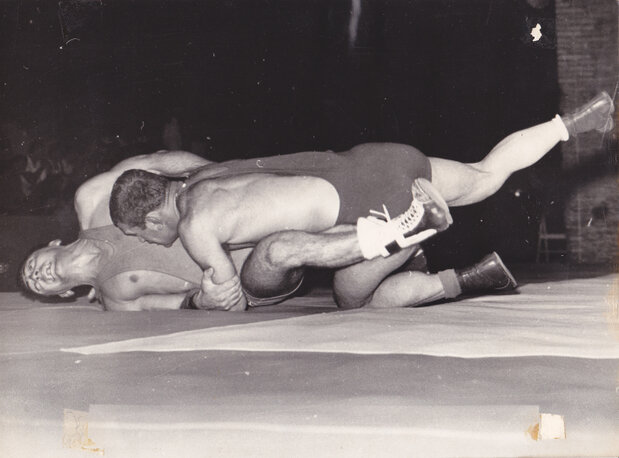
Koridze nell'incontr che lo ha visto vincente contro l'italiano Mario De Silva
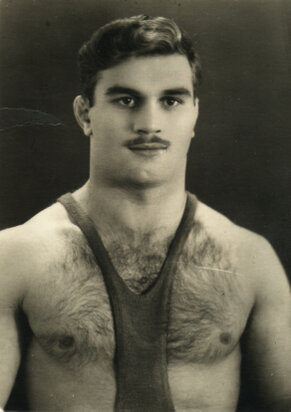
Avtandil Koridze
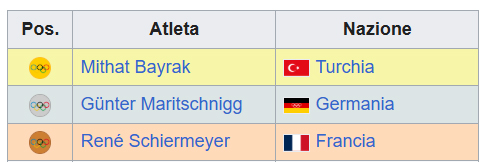
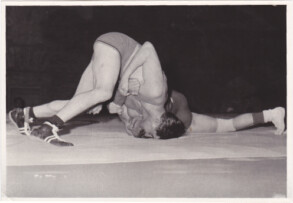
Maritschnigg batte l'americano Fritz Fivian
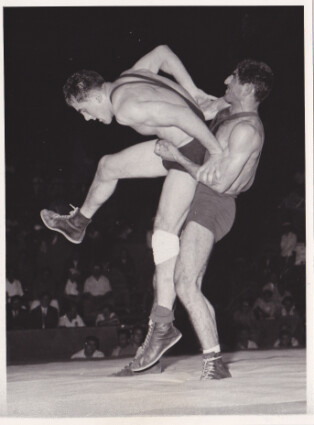
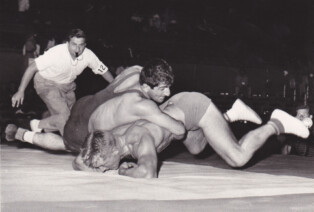
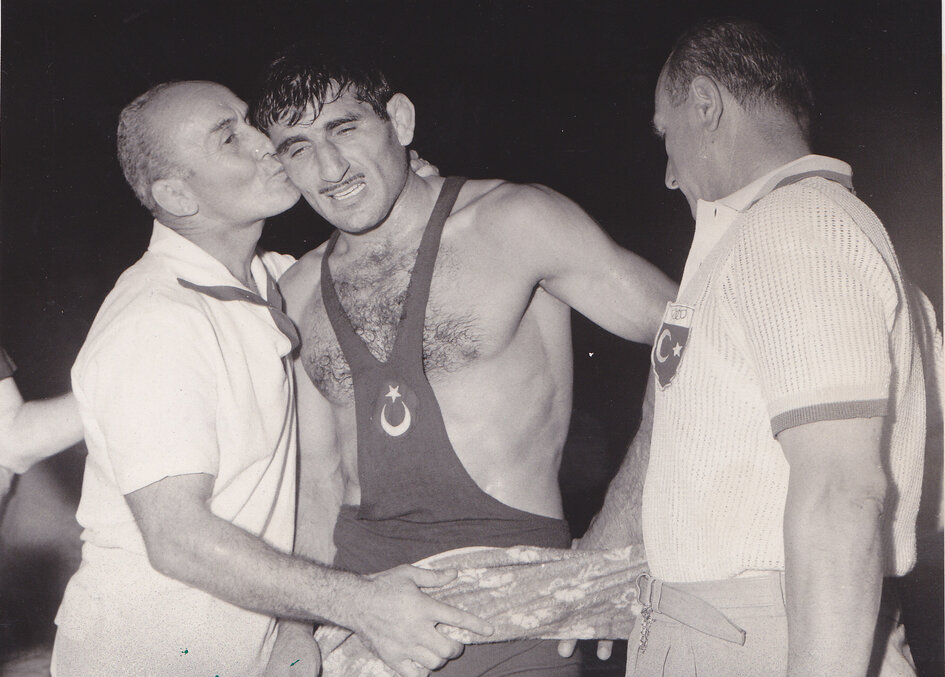
ll campione olimpico di Roma '60 durante gli incontri contro l'austriaco Berger e contro lo svedese Nystrom, nella terza foto (sotto) la gioia di Bayrak dopo la vittoria
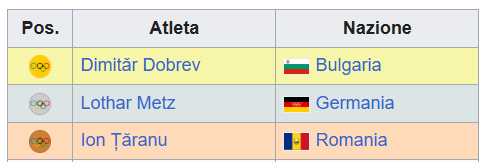
Nella categoria dei pesi Medi un Bulgaro, Dimitar Dobrev, successo al sovietico Kartozjia sul trono di Olimpia. Al limite dei 79 Kg. le tattiche cominciavano ad essere molto attendiste, le prese molto classiche e prevedibili e bulgari e turchi, assieme ai sovietici, salirono in cattedra. Dobrev cominciò battendo il portoghese Caldas e poi il sovietico Chucalov. Poi si sbarazzò dello svedese Israelsson e si trovò in testa nel turno successivo ma al pari di penalità con il romeno Ion Taranu ed il turco Kazim Ayvaz, bisognava combattere con entrambi. Dobrev li regolò entrambi per 3 a 1. Nello spareggio per l'argento e il bronzo la spunto Taranu.
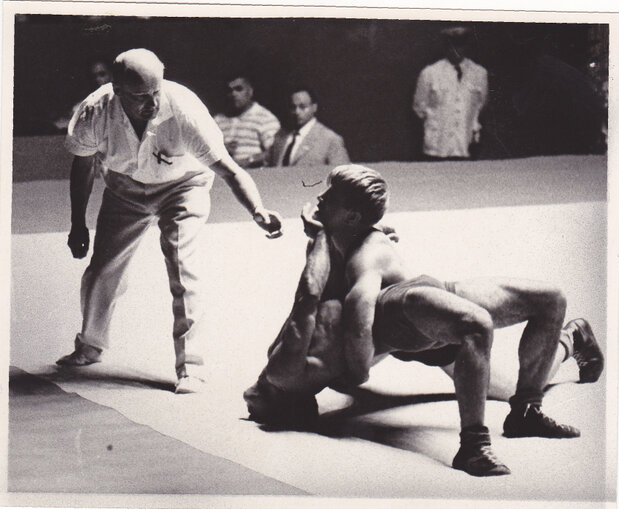
Durante il match di semifinale tra Dobrev e il turco Kazım Ayvaz
In the middleweight category, a Bulgarian, Dimitar Dobrev, defeated the Soviet Kartozjia for the title at Olympia. At the 79-kg weight limit, tactics began to take a very wait-and-see approach, with very classic and predictable grips, and the Bulgarians and Turks, along with the Soviets, took center stage. Dobrev started by defeating the Portuguese wrestler Caldas and then the Soviet wrestler Chucalov. He then disposed of the Swede Israelsson and found himself in the lead in the next round, but tied on penalties with the Romanian Ion Taranu and the Turk Kazim Ayvaz, so he had to face both of them. Dobrev defeated both of them 3–1. In the playoff for the silver and bronze medals, Taranu came out on top.
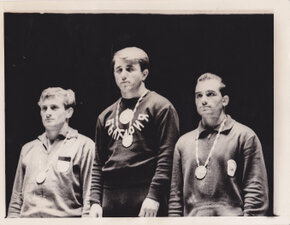
Il podio dei pesi Medi
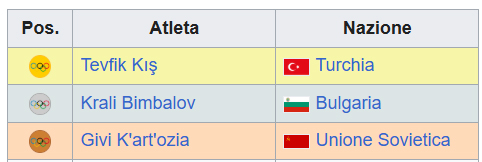
Nei pesi Medio-Massimi, al limite degli 87 Kg., parteciparono in 17. Il grande favorito era l'olimpionico sovietico Givi Kartozjia, che non era molt alto (1,76) e il suo baricentro basso lo rendeva non ribaltabile nella lotta in piedi, in quella a terra si difendeva benissimo. Kartozjia superò quattro concorrenti pria di ritrovarsi di fronte il lottatore che lo precedeva in classifica, il magiaro Peter Piti. Lo piegò ai punti e si venne così a trovare un quartetto per le fasi finali, oltre al sovietico, ancora il magiaro Piti, il bulgaro Bimbalov ed il turco Kis. Nella semifinale Bimbalov eliminò Piti e Kartozjia dovette cedere al turco Kis. Il turco ed il bulgaro terminarono a pari penalità (6) e il titolo, da regolamento, venne assegnato al turco Tevfik Kis.
In the light heavyweight division, with a weight limit of 87 kg, 17 competitors took part. The heavy favorite was the Soviet Olympic champion Givi Kartozjia, who wasn’t very tall (1.76) and whose low center of gravity made him impossible to knock down in stand-up fighting; on the ground, he defended himself very well. Kartozjia defeated four opponents before facing the wrestler ranked above him, the Hungarian Peter Piti. He defeated him on points, and thus a quartet advanced to the final rounds: in addition to the Soviet wrestler, there was the Hungarian Piti, the Bulgarian Bimbalov, and the Turkish wrestler Kis. In the semifinals, Bimbalov eliminated Piti, and Kartozjia was defeated by the Turkish wrestler Kis. The Turkish and Bulgarian wrestlers finished with the same number of penalties (6), and according to the rules, the title was awarded to the Turkish wrestler Tevfik Kis.
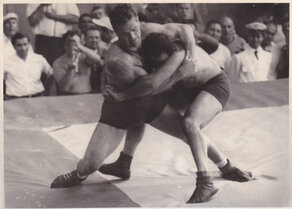
Kartoozjia contro Albrecht
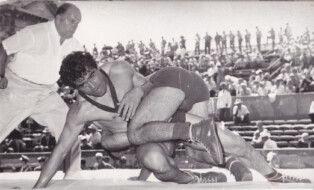
Bimbalov contro Kis

Kartozjia contro Vankannen
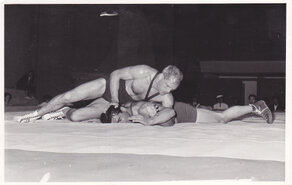
Kis contro Rusterholz
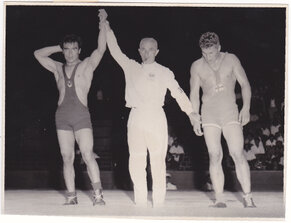
Kis contro Vankannen
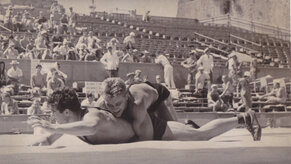
Kis contro Simoleski
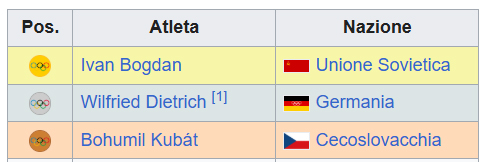
Il gran finale del torneo di Lotta Greco-Romana si ebbe con l'assegnazione della medaglia d'oro nella categoria dei pesi Massimi, cioé ai lottatori oltre gli 87 Kg. 12 i partecipanti al torneo e tra i grandi favoriti l'italiano Adelmo Bulgarelli e grazie alla sua presenza, i biglietti per questo ultimo torneo andarono a ruba. Principale antagonista di Bulgarelli, secondo gli esperti, sarebbe dovuto essere il bulgaro Radoslav Kassabov. Ma come spesso è capitato in questa specialità, gli esperti ebbero ancora una volta torto in quanto tra i finalisti non figurava il favorito Bulgarelli e il bulgaro venne poi eliminato nei quarti dal tedesco Wilfried Dietrich (che alla fine si aggiudicò l'argento). L'oro lo vinse il sovietico Ivan Bogdan che nell'ultimo e decisivo match pareggiò con Karel Kubat, lasciando a quest'ultimo il bronzo.
The grand finale of the Greco-Roman wrestling tournament took place with the awarding of the gold medal in the heavyweight division—that is, for wrestlers weighing over 87 kg. There were 12 participants in the tournament, and among the top favorites was the Italian Adelmo Bulgarelli; thanks to his presence, tickets for this final tournament sold out quickly. According to the experts, Bulgarelli’s main rival was supposed to be the Bulgarian Radoslav Kassabov. But as has often happened in this sport, the experts were once again wrong, as the favorite, Bulgarelli, did not make it to the finals, and the Bulgarian was subsequently eliminated in the quarterfinals by the German Wilfried Dietrich (who ultimately won the silver medal). The gold medal was won by the Soviet Ivan Bogdan, who tied with Karel Kubat in the final, decisive match, leaving Kubat with the bronze.
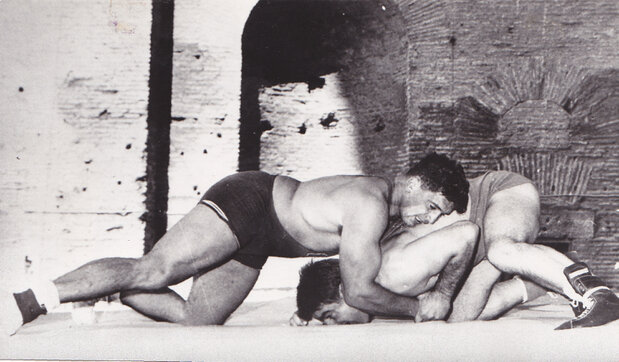
Bulgarelli contro Lewis
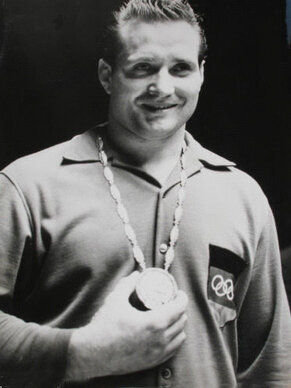
Manfred Dietrich - Argento
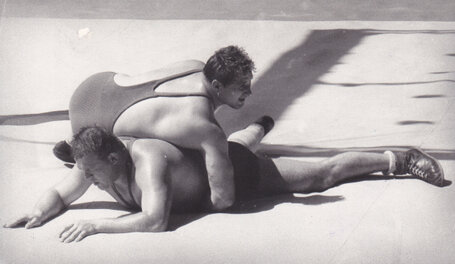
il match tra Dietrich e Kubat
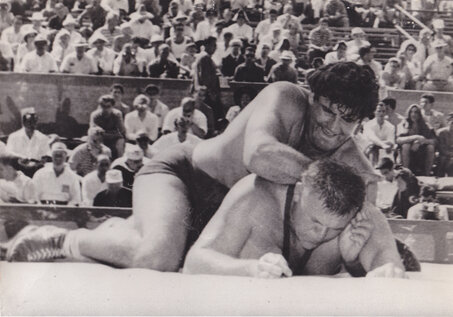
Bogdan contro Kubat

