Vai ai contenuti

Le altre gare - Le Olimpiadi d'Italia

Salta menù
LE OLIMPIADI D'ITALIA
Salta menù

Le altre gare

Le altre gare - The other competitions

Peter Snell (800 metri maschili)


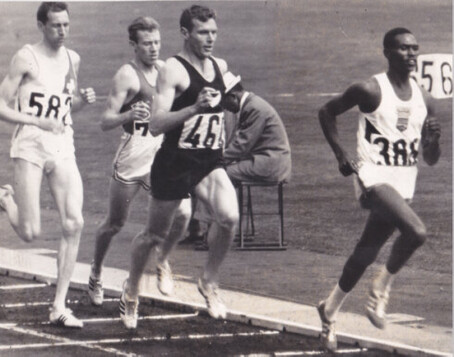
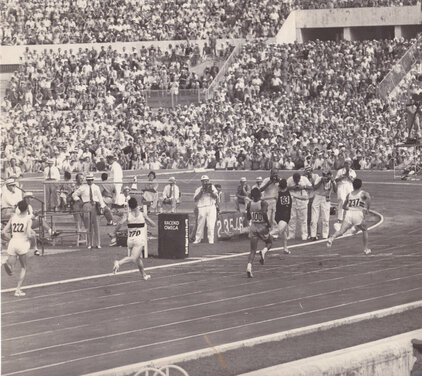
Negli 800 metri, dopo la sorpresa della eliminazione di tutti i concorrenti statunitensi, vinse a tempo di record il neozelandese Peter Snell, prima medaglia d'oro non americana sulla distanza dal 1932.

In the 800 meters, after the surprise elimination of all American competitors, New Zealander Peter Snell, the first non-American gold medalist in the distance since 1932, won in record time.
Ljudmila Lysenko Shevtsova (800 metri femminili)


L'8 settembre si svolse la gara degli 800 metri femminili, rientrata nel programma olimpico dopo 32 anni (l'ultima volta si era disputata ad Amsterdam nel 1928). Questa finale era l'Oceania contro l'Europa, infatti le nove concorrenti provenivano dall'Australia (Brenda Jones e Dixie Willis), dalla Germania (Antje Gleichfeld, Ursula Donath e Veronika Kummerfeldt), dall'Unione Sovietica (Ljudmila Lysenko Shevtsova, primatista del mondo), dalla Gran Bretagna (Joy Jordan), dall'Ungheria (Gizella Csoka) e dalla Polonia (Beata Zbikowska). Allo sparo partirono in tromba e Dixie Willis si incaricò di fare l'andatura e guidando il gruppo al primo giro con la Shevcova la Jones e la Donath alle calcagna. La Willis a 50 metri dall'arrivo, scartò di lato dalla pista e finì sul prato esanime. La volata finale vide tagliare per prima il traguardo la Shevtsova (con record mondiale 2'4"03) davanti alla Jones ed alla Donath.
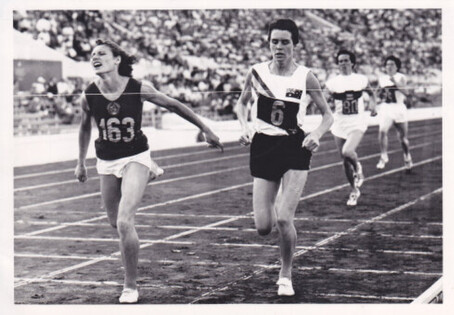
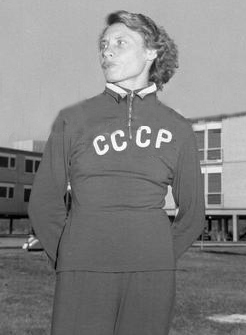
On September 8, the women's 800-meter race took place, returning to the Olympic program after 32 years (the last time it was held in Amsterdam in 1928). This final was Oceania against Europe, in fact the nine contestants came from Australia (Brenda Jones and Dixie Willis), Germany (Antje Gleichfeld, Ursula Donath and Veronika Kummerfeldt), the Soviet Union (Ljudmila Lysenko Shevtsova, world record holder), Great Britain (Joy Jordan), Hungary (Gizella Csoka) and Poland (Beata Zbikowska). At the shot they started on the trumpet and Dixie Willis took charge of setting the pace and leading the group on the first lap with Shevcova, Jones and Donath hot on her heels. The Willis, 50 meters from the finish, swerved sideways off the track and ended up lifeless on the lawn. The final sprint saw Shevtsova (with a world record of 2'4"03) cross the finish line first, ahead of Jones and Donath.
Vladimir Golubnichiy (20 Km di marcia)


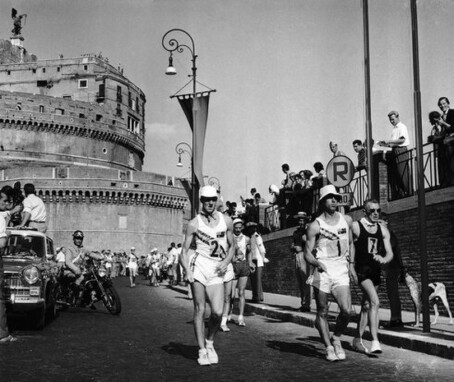
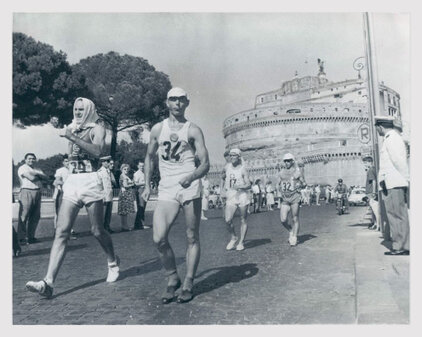
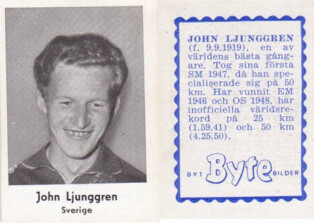
Il 2 settembre, si disputò la gara di marcia sui 20 km., La gara vedeva la partenza e l'arrivo allo Stadio Olimpico e si disputava in un tracciato nella zona tortuosa del Foro Italico. Il più accreditato per la vittoria finale era il sovietico Anatoliy Vedyakov, in assenza dei tre del podio di Melbourne 1956, possibili contendenti lo svedese Ljunggren, gli inglesi Hall, Matthews e Vickers e il tedesco Lindner. Al quinto km. passò primo Matthews seguito da tutti gli altri che, a causa del caldo di quella estate romana, si coprivano il capo con qualsiasi cosa, 'unico a cui l'umidità romana non dava fastidio era l'indiano Zora Singh, nonostante la sua lunga barba e i lunghi capelli. Al quinto giro Vladimir Golubnichiy portò il suo attacco, prese il comando delle operazioni e non lo lasciò più. Dietro di lui si avvicinarono Matthews e Solodov ma fu Freeman l'unico a insidiargli  la vittoria negli ultimi metri. Vickers, con uno sprint finale, riuscì ad agguantare la medaglia di bronzo.
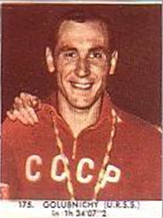
On September 2, the 20 km walk race was held. The race started and finished at the Stadio Olimpico and was held on a track in the winding area of the Foro Italico. The most likely winner was Soviet Anatoliy Vedyakov, in the absence of the three from the 1956 Melbourne podium, possible contenders were Sweden's Ljunggren, England's Hall, Matthews and Vickers and Germany's Lindner. On the fifth km. Matthews passed first, followed by all the others who, due to the heat of that Roman summer, covered their heads with anything, the only one who was not bothered by the Roman humidity was the Indian Zora Singh, despite his long beard and long hair. On lap five Vladimir Golubnichiy brought his attack, took command of the operations and never left it. Matthews and Solodov approached behind him but it was Freeman who was the only one who threatened him with victory in the final metres. Vickers, with a final sprint, managed to capture the bronze medal.
Irina Press (80 metri ostacoli)


La finale della gara degli 80 metri ad ostacoli femminile, vide ai nastri di partenza tre atlete sovietiche (Press, Bystrova e Kosheleva), la tedesca Birkemeyr e le britanniche Quinton e Brignal. Allo sparo dello starter la tedesca fu bruciata da Irina Press, che partì come un missile superando, senza fatica, il primo ostacolo. Poi, grazie al suo perfetto stile, prese quell'esiguo vantaggio che mantenne fino alla fine della corsa, chiudendo in 10"2. Seconda l'inglese Carole Quinton (10"9) e terza la tedesca Gisela Birkemeyer.
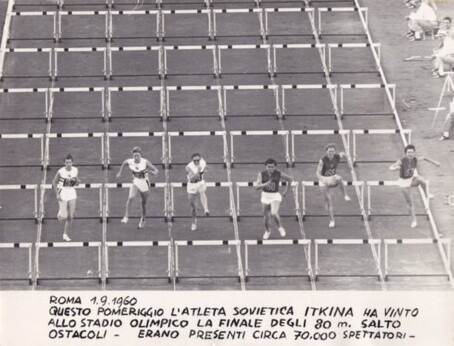
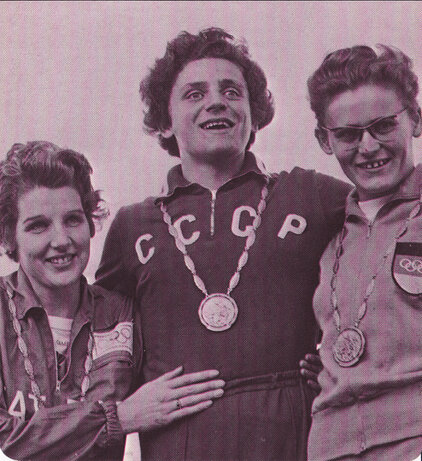
The final of the women's 80m hurdles race saw three Soviet athletes (Press, Bystrova and Kosheleva), Germany's Birkemeyr and Britain's Quinton and Brignal at the starting line. When the starter fired, the German was burned by Irina Press, who launched like a missile, easily overcoming the first obstacle. Then, thanks to his perfect style, he took that slim lead that he maintained until the end of the race, finishing in 10"2. Second was England's Carole Quinton (10"9) and third was Germany's Gisela Birkemeyer.
Murray Halberg (5000 metri femminili)


La finale dei 5000 metri, che vedeva favorito il neozelandese Murray Halberg, si disputò alle ore 17,12 del 2 settembre. Nei primi due giri si alternarono il polacco Zimmy ed il tedesco Janke. A metà gara Halberg mosse dalla settima posizione portandosi alle spalle del treno che guidava il gruppo. Al quinto giro si era formato un sestetto che aveva creato un leggero distacco con il resto del gruppo, tra questi Halberg, il tedesco Grodotzki, Zimmy poi Thomas, Power e il keniano Maiyoro.
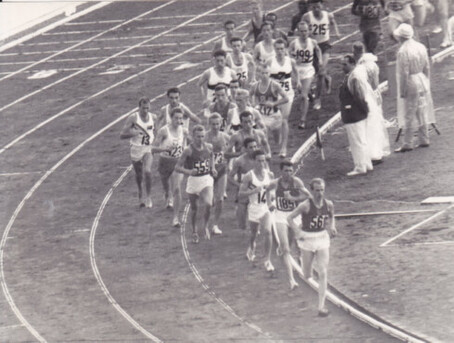
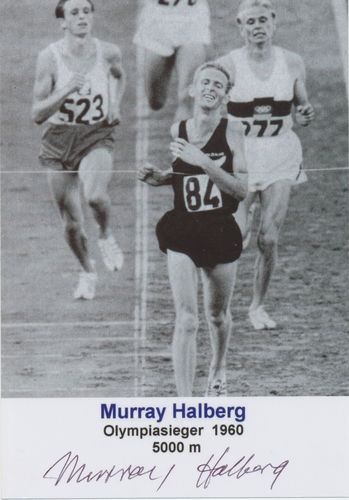
The 5000m final, which saw New Zealander Murray Halberg as the favourite, was held at 5.12pm on 2 September. In the first two laps, Polish Zimmy and German Janke alternated. At the halfway point of the race Halberg moved from seventh place, moving behind the train leading the group. On lap five, a sextet had formed that had created a slight gap with the rest of the group, including Halberg, the German Grodotzki, Zimmy then Thomas, Power and the Kenyan Maiyoro.

A tre giri dal termine Halberg cambiò marcia, involandosi da solo, come se il traguardo fosse dopo la curva successiva e nulla poté il tedesco, nonostante un'ottima rimonta nel finale. Al terzo posto Zimmy.

With three laps to go, Halberg shifted gears, flying on his own, as if the finish line were after the next corner and the German could do nothing, despite an excellent comeback at the end. In third place Zimmy..
Zdzyslaw Krzyszkowiak (3000 siepi)


Il 3 settembre, alle ore 16,50, ebbe inizio una delle gare più faticose tra quelle che si disputano in una pista di atletica: i 3000 siepi. Nelle semifinali i tempi migliori erano stati realizzati dai due atleti sovietici (Sokolov e Rzhistchin) e dal polacco Zdzyslaw Krzyszkowiak e furono proprio questi tre atleti a dominare la gara. Durante la gara i due sovietici, aiutati dal compagno Konov che fece da lepre fin dal primo giro, forzarono l'andatura per distaccare l'unico vero rivale, il polacco, primatista mondiale della specialità. E fu proprio il quest'ultimo a tagliare per primo il traguardo, con uno sprint finale grazie alla sua falcata di grande potenza ed eleganza, alle sue spalle Nikolay Sokolov e Semen Rzhistchin.
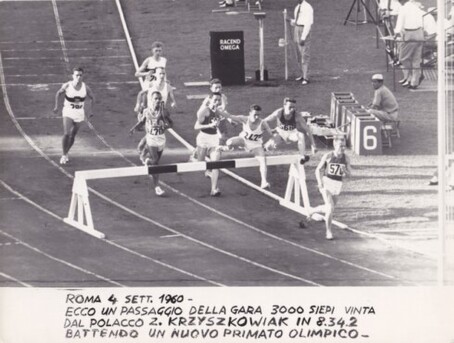
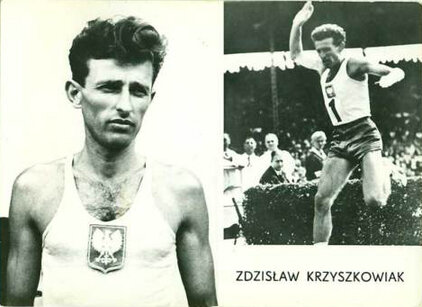
On September 3, at 4:50 pm, one of the most tiring races held on an athletics track began: the 3000m steeplechase. In the semi-finals, the best times had been set by the two Soviet athletes (Sokolov and Rzhistchin) and the Polish Zdzyslaw Krzyszkowiak and it was these three athletes who dominated the race. During the race, the two Soviets, aided by their teammate Konov, who acted as hare from the first lap, forced their pace to distance their only real rival, the Pole, the world record holder in the specialty. And it was the latter who crossed the finish line first, with a final sprint thanks to his stride of great power and elegance, behind him Nikolay Sokolov and Semen Rzhistchin.
Lee Calhoun (110 metri ostacoli)


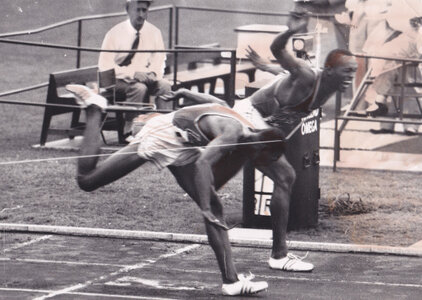
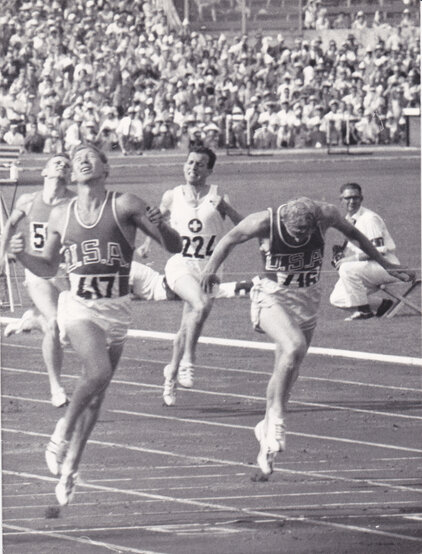
Alle 16,45 del 5 settembre si disputò la gara dei 110 ostacoli. Favorito di questa gara era il tedesco Martin Lauer che, in questa finale, doveva vedersela con i tre neri d'America: Lee Calhoun, Willie May e Hayes Jones. Lauer, in corsia 5, aveva gli americani alle corsie 4, 2 e 1, le altre due corsie erano occupate dal giamaicano Gardner e dal sovietico Chistyakov. Allo start, il più veloce a lasciare i blocchi fu Calhoun che sfiorò il primo ostacolo (non gli era mai accaduto). Capitò la stessa cosa a Lauer che quasi incespicò sull'ostacolo perdendo il ritmo per un istante, poi quando sembrava stesse recuperando, urtò anche il quinto e sesto ostacolo, immettendosi nella volata finale in quarta posizione.
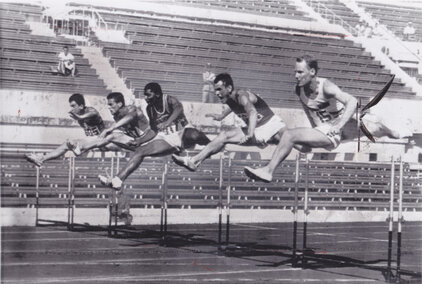
The 110m hurdles race was held at 4.45pm on 5 September. The favorite of this race was the German Martin Lauer who, in this final, had to face the three black Americans: Lee Calhoun, Willie May and Hayes Jones. Lauer, in lane 5, had the Americans in lanes 4, 2 and 1, the other two lanes were occupied by Jamaican Gardner and Soviet Chistyakov. At the start, the quickest to leave the blocks was Calhoun who came close to the first obstacle (it had never happened to him). The same thing happened to Lauer who almost stumbled on the obstacle, losing his rhythm for a moment, then when he seemed to be recovering, he also hit the fifth and sixth obstacles, entering the final sprint in fourth place.

Calhoun, che controllava il tedesco, non si accorse del sopraggiungere di May e dovette sprintare, tagliando il filo di lana con la testa ed aggiudicandosi l'oro, ma solo dopo il fotofinish, essendo giunto sul traguardo con lo stesso tempo di May (13"8).  
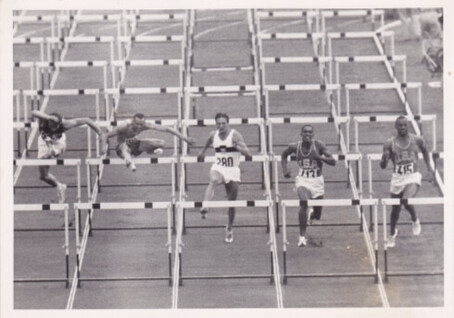

Calhoun, who controlled the German, did not notice May's arrival and had to sprint, cutting the woolen thread with his head and winning the gold, but only after the photo finish, having reached the finish line with the same time as May (13"8).  
Donald Thompson (50 Km marcia)


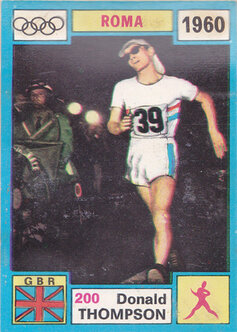
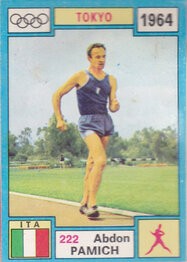
La 50 chilometri di marcia si svolse nel pomeriggio del 7 settembre. Trentanove i partecipanti al via di ventuno nazioni diverse. Il percorso studiato prevedeva la partenza dallo Stadio Olimpico, l'attraversamento di diversi quartieri romani fino ala Magliana e poi Acilia per far ritorno allo Stadio Olimpico, dopo circa 5 ore di gara. Al passaggio di Acilia, quindi a metà gara, l'inglese Donald Thompson era già in vantaggio di oltre un minuto sullo svedese Ljunggren e sull'ucraino Sthcherbina. Poi lo svedese si scatenò, superò Thompson e lo distaccò di oltre 30 secondi. Al quarantesimo chilometro Thompson ripassò in vantaggio con una decina di secondi sullo svedese e un paio di minuti sull'italiano Pamich che nel frattempo aveva a sua volta distaccato l'ucraino Sthcherbina. A tre chilometri dall'arrivo, Thompson portò il suo vantaggio a 20 secondi, vantaggio che portò fino al traguardo e chiudendo in 4 or 25 minuti e 30 secondi, nuovo record olimpico. Secondo lo svedese John Ljiunggren e terzo, ad oltre due minuti e mezzo, l'italiano Abdon Pamich.


The 50-kilometer march took place on the afternoon of September 7. Thirty-nine participants at the start from twenty-one different nations. The route studied included starting from the Stadio Olimpico, crossing several Roman neighborhoods to Ala Magliana and then Acilia to return to the Stadio Olimpico, after about 5 hours of competition. By the time Acilia passed, midway through the match, England's Donald Thompson was already more than a minute ahead of Sweden's Ljunggren and Ukraine's Sthcherbina. Then the Swede went wild, overtook Thompson and outpaced him by more than 30 seconds. At the fortieth kilometer Thompson regained the lead with about ten seconds over the Swede and a couple of minutes over the Italian Pamich who in the meantime had in turn detached the Ukrainian Sthcherbina. With three kilometers to go, Thompson extended his lead to 20 seconds, a lead he took to the finish line and finished in 4 or 25 minutes and 30 seconds, a new Olympic record. According to Swede John Ljiunggren and third, at over two and a half minutes, Italian Abdon Pamich.  
Pyotr Bolotnikov (10000 metri maschili)


Nella gara dei 10000 metri il gruppo dei favoriti, non essendo previste qualificazioni ma una finale secca, era composto, a dire degli esperti del tempo, dal sovietico Pyotr Bolotnikov, dal campione d'Europa il tedesco Hans Grodotzki, da Murray Halberg, vincitore della gara dei 5000 ed dall'inglese Gordon Pirie. Intorno alle 16,30 di quell'8 settembre, i 32 partecipanti alla gara si allinearono sulla linea di partenza in attesa dello sparo che dava il via alla gara. Subito alla partenza furono i tre sovietici (oltre a Bolotnikov erano in gara anche Desyatchikov e Zhukov) a fare l'andatura, un'andatura sostenuta in modo da sfiancare gli avversari. Dopo i primi giri fu Zhukov che prese il comando con qualche metro di vantaggio sul gruppo, seguito però, dal marocchino Abdesselem, poi Bolotnikov raggiunse il compagno lì davanti ed insieme tentarono la prima fuga, bloccata, dopo un paio di giri, dall'ungherese Iharos e dall'australiano Power. La fila andò allungandosi e Pirie, Grodotzki ed Halberg si mantenevano al centro del gruppone. A metà gara, Martin Hyman, provenendo dalle retrovie, con uno scatto incredibile raggiunse i primi ed addirittura li staccò di una ventina di metri. Power, Rhadi, Iharos e Bolotnikov chiusero immediatamente il gap ed il sovietico riprese la testa della corsa. Ai 9000 metri cominciarono i preparativi per il gran finale. Davanti oramai rimanevano a fare la gara solamente il tedesco, i due sovietici e l'australiano Power, gli altri erano spariti. A 600 metri dall'arrivo Bolotnikov superò Grodotzki e al suono della campana dell'ultimo girò ripartì ancora innestando una marcia più alta, invano inseguito dagli altri. Il sovietico si presentò solo in dirittura d'arrivo e con un ultimo sprint taglio il filo con un tempo vicino vicino al record mondiale ma stabilendo il nuovo primato olimpico (28'32"2). Dietro di lui, lontano 5 secondi, il tedesco Grodotzk che precedeva di poco l'australiano Power.
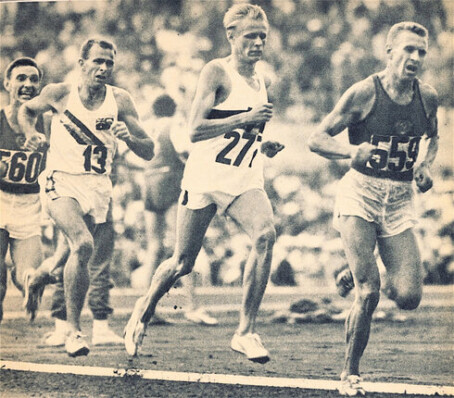
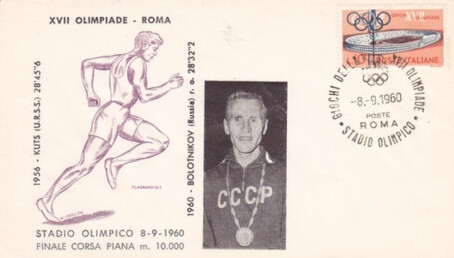
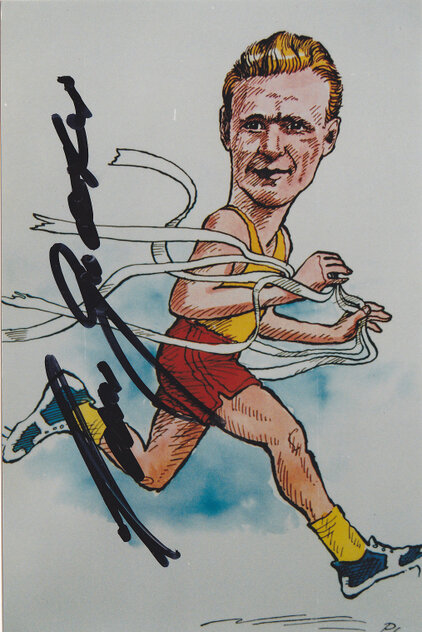
In the 10,000-meter race, the group of favorites, since there were no qualifications but a one-off final, was composed, according to time experts, of the Soviet Pyotr Bolotnikov, the European champion Hans Grodotzki of Germany, Murray Halberg, winner of the 5,000-meter race and the Englishman Gordon Pirie. Around 4:30 p.m. on September 8, the 32 race participants lined up on the starting line awaiting the shot that started the race. Immediately at the start, it was the three Soviets (in addition to Bolotnikov, Desyatchikov and Zhukov were also competing) who set the pace, a sustained pace in order to exhaust their opponents. After the first laps, Zhukov took the lead with a few metres' advantage over the group, followed, however, by the Moroccan Abdesselem, then Bolotnikov caught up with his teammate there in front and together they attempted their first breakaway, blocked, after a couple of laps, by the Hungarian Iharos and the Australian Power. The line grew longer, and Pirie, Grodotzki, and Halberg remained in the center of the group. At the halfway point of the race, Martin Hyman, coming from the back, reached the front with an incredible sprint and even took them about twenty metres away. Power, Rhadi, Iharos and Bolotnikov immediately closed the gap and the Soviet regained the lead. Preparations for the grand finale began at the 9000 meters. At the front, only the German, the two Soviets and the Australian Power remained to compete, the others had disappeared. With 600 meters to go, Bolotnikov overtook Grodotzki and at the sound of the bell of the last turn he set off again, shifting into a higher gear, pursued in vain by the others. The Soviet showed up only on the home stretch and with a final sprint he cut the line with a time close to the world record but setting a new Olympic record (28'32"2). Behind him, 5 seconds away, was the German Grodotzk who was just ahead of the Australian Power.
Glenn Davis (400 metri ostacoli)


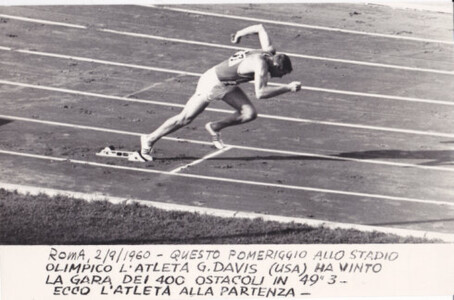
La finale dei 400 ostacoli, partì alle ore 16.00 del 2 settembre e vide ai blocchi di partenza gli americani Glenn Davis, Cliff Cushman e Dick Howard, il tedesco Helmut Janz, il finnico Jussi Rintamaki e lo svizzero Bruno Galliker. Dopo lo sparo dello starter, Davis saltò il primo ostacolo in maniera pulita, ma al secondo toccò l'asticella e si scompose disturbando la sua progressione fino al sesto ostacolo. Negli ultimi 150 metri recuperò la coordinazione ed al nono ostacolo superò prima il francese e poi i suoi due connazionali. Sprintò sul rettilineo e chiuse in 49"3, record olimpico ad un centesimo dal suo record mondiale. Cushman e Howard gli arrivarono dietro aggiudicandosi, rispettivamente, argento e bronzo.
The 400m hurdles final started at 4pm on 2 September and saw Americans Glenn Davis, Cliff Cushman and Dick Howard, German Helmut Janz, Finnish Jussi Rintamaki and Swiss Bruno Galliker at the starting blocks. After the starter fired, Davis jumped the first obstacle cleanly, but hit the bar on the second and broke down, disrupting his progression to the sixth obstacle. In the last 150 metres he regained his coordination and at the ninth obstacle he first overtook the Frenchman and then his two compatriots. He sprinted down the straight and finished in 49.3, an Olympic record one hundredth of a second shy of his world record. Cushman and Howard finished behind him, winning silver and bronze respectively.
Torna ai contenuti