Short Track
TORINO 2006 > LE GARE > Pattinaggio
SHORT TRACK
VELOCITA' E FORZA PER RAGGIUNGERE IL TRAGUARDO
SPEED AQND STRENGTH TO REACH THE FINISH LINE
Quì, a differenza del Pattinaggio di velocità su ghiaccio (oltre alla pista più corta che prevede curve più strette) non esistono le corsie, cosa che permette contatti tra gli atleti, e si corre dai 4 agli 8 atleti massimo per volta.
Here, unlike speed skating on ice (in addition to the shorter track which features tighter turns), there are no lanes, which allows contact between athletes, and a maximum of 4 to 8 athletes are run at a time.

Le gare di short track ai XX Giochi olimpici invernali si sono svolte dal 12 al 25 febbraio al Palavela di Torino. 8 le medaglie assegnate, 4 per gli uomini e 4 per le donne.
The short track events at the XX Olympic Winter Games took place from February 12 to 25 at the Palavela in Turin. Eight medals were awarded, four for men and four for women.
SHORT TRACK: UN RE DI 20 ANNI - SHORT TRACK: A KING OF 20 YEARS
Ahn Hyun-Soo, sudcoreano dello short track, 20 anni, è l'uomo che ha vinto più medaglie a Torino. Tre ori (1.000 e 1.500 metri, staffetta) e un bronzo (500 metri) per sigillare lo strapotere sudcoreano sulla disciplina e contendere i riflettori a uno dei personaggi più attesi, lo statunitense Apolo Anton Ohno, che comunque conquista Toro nei 500, il bronzo nei 1.000 e nella staffetta. E pensare che proprio Ahn Hyun-Soo, l'universitario che ama il cinema, era stato uno dei quattro finalisti caduti rovinosamente a Salt Lake 2002, dando il via libera all'incredibile oro dell'australiano Steven Bradbury. (dal Rapporto Ufficiale del C.O.)
Ahn Hyun-Soo, a 20-year-old South Korean short track athlete, is the man who won the most medals in Turin. Three gold medals (1,000 and 1,500 meters, relay) and a bronze (500 meters) to seal South Korea's overwhelming power in the discipline and compete for the spotlight with one of the most anticipated figures, American Apolo Anton Ohno, who nevertheless won Toro in the 500 meters, bronze in the 1,000 meters and in the relay. And to think that Ahn Hyun-Soo, the film-loving college student, was one of the four finalists who fell disastrously at Salt Lake 2002, giving the green light to Australian Steven Bradbury's incredible gold medal.
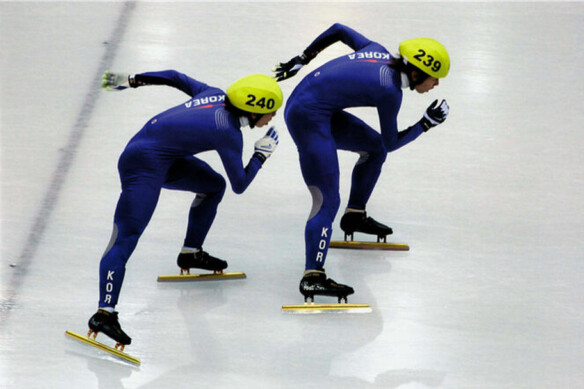
La doppietta coreana nei 1.500 metri dello short track: Ahn Hyun-Soo, alle sue spalle Lee Ho-Suk, alla fine oro e argento (dal Rapporto Ufficiale)
Korea scored a one-two in the 1,500 metre short track event: Ahn Hyun-Soo and Lee Ho-Suk took gold and silver in the end
Korea scored a one-two in the 1,500 metre short track event: Ahn Hyun-Soo and Lee Ho-Suk took gold and silver in the end
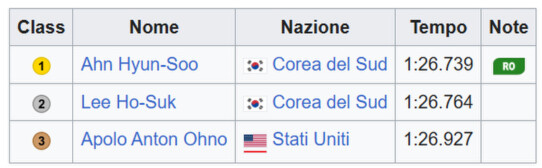
1000 metri maschile - Men's 1000 meters
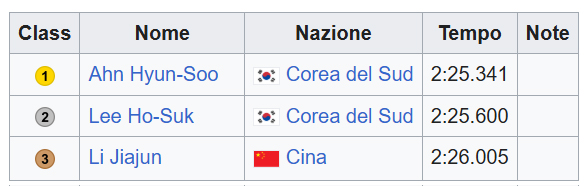
1500 metri maschile - Men's 1500 meters
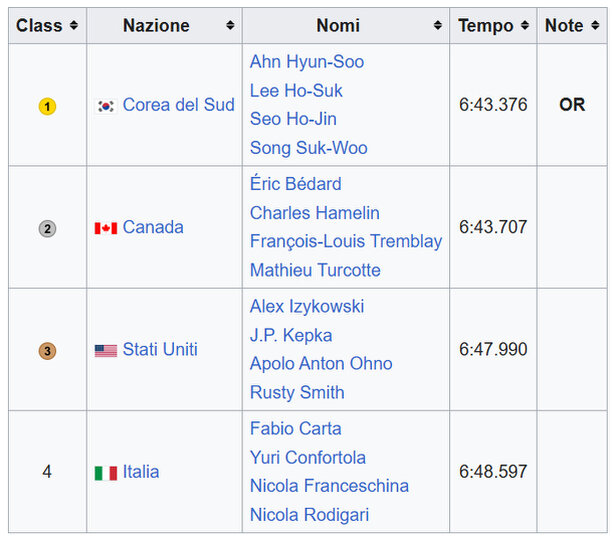
Staffetta 5000 metri maschile - Men's 5000-meter relay
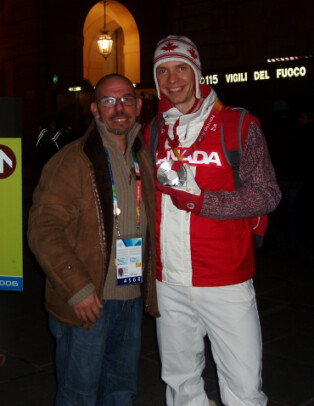
io e François-Louis Tremblay, argento a squadre e nei 500 metri

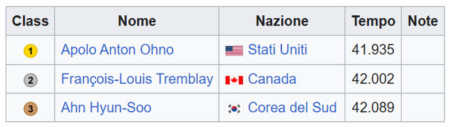
500 metri maschile - Men's 500 meters
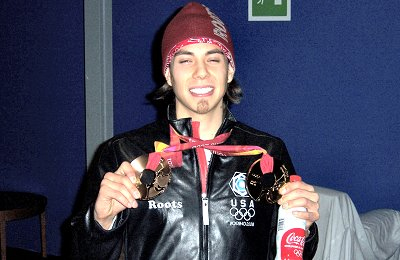
(dal Rapporto Ufficiale)
SHORT TRACK: LA PALLOTTOLA DI CERAMICA - SHORT TRACK: THE CERAMIC BULLET
Anche in ambito femminile lo short track conferma la superiorità sudcoreana con il triplo oro (1.000 e 1.500 metri, staffetta) della giovanissima Jin Sun-Yu, 18 anni a dicembre 2006, 57 chili distribuiti lungo 167 centimetri, una pallottola di ceramica già capace di laurearsi Campione del Mondo pur avendo debuttato in nazionale solo nel 2004. Come atteso, solo i 500 metri, fra le donne, mescolano le carte, con l'oro alla ventenne cinese Meng Wang. L'Italia, con il bronzo nella staffetta (Capurso, Fontana, Katia e Mara Zini), conquistala centesima medaglia della sua storia ai Giochi Invernali. (dal Rapporto Ufficiale del C.O.)
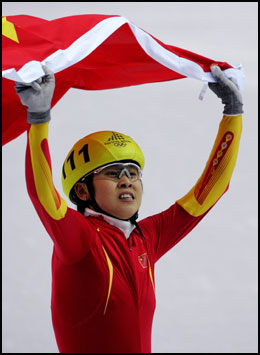
(dal Rapporto Ufficiale)
The South Koreans dominated women's short track speed skating thanks to the three golds (1,000 and 1,500 m, relay) taken home by 18-year-old Jin Sun-Yu who, despite her petit frame, became World Champion just two years after making her debut in the Korean national championships in 2004. As forecast only the women's 500 m broke the Korean's run, with the gold medal going to Meng Wang of China. Italy took bronze in the relay (Capurso, Fontana, Katia and Mara Zini), the 100 th medal in the Country's Olympic Winter Games history.
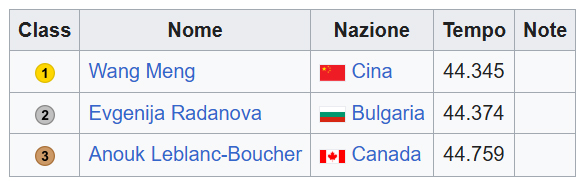
500 metri femminile - Women's 500 meters
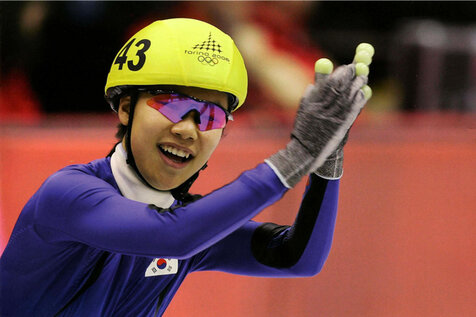
(dal Rapporto Ufficiale)
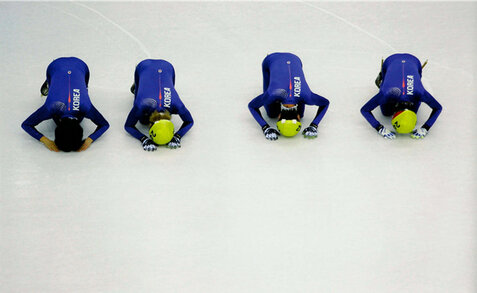
Il quartetto coreano celebra così la vittoria nella staffetta 5.000 metri, davanti a canadesi e statunitensi (dal Rapporto Ufficiale)
The four Koreans celebrate beating the Canadians and Americans to victory in the the 5,000 metre relay
The four Koreans celebrate beating the Canadians and Americans to victory in the the 5,000 metre relay
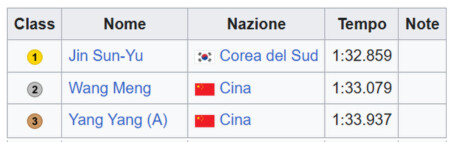
1000 metri femminile - Women's 1000 meters
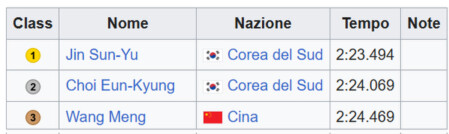
1500 metri femminile - Women's 1500 meters
Colpo di scena dell’ultimo cambio della staffetta femminile 3000 metri, quando il podio sembra ormai essere occupato dalle solite potenze, le stesse di Salt Lake City: Corea del Sud, Cina e Canada. Ma c’è un’irregolarità delle cinesi proprio all’ultimo cambio: Marta Capurso, attaccata orgogliosamente alle prime tre, si trova sbarrata la strada da un’avversaria che non ha liberato la pista dopo aver ceduto il testimone a una compagna. Momenti di grande pathos, un’attesa di pochi minuti e poi il boato del Palavela: è bronzo per l'Italia (l’oro è andato alla Corea, l’argento al Canada).
The final change of the women's 3000-meter relay is a dramatic turn of events, when the podium now seems to be occupied by the usual powers, the same ones in Salt Lake City: South Korea, China, and Canada. But there was an irregularity for the Chinese right at the last change: Marta Capurso, proudly attached to the top three, found herself blocked by an opponent who failed to clear the track after handing over the baton to a teammate. Moments of great pathos, a wait of a few minutes and then the roar of the Palavela: it's bronze for Italy (gold went to Korea, silver to Canada).
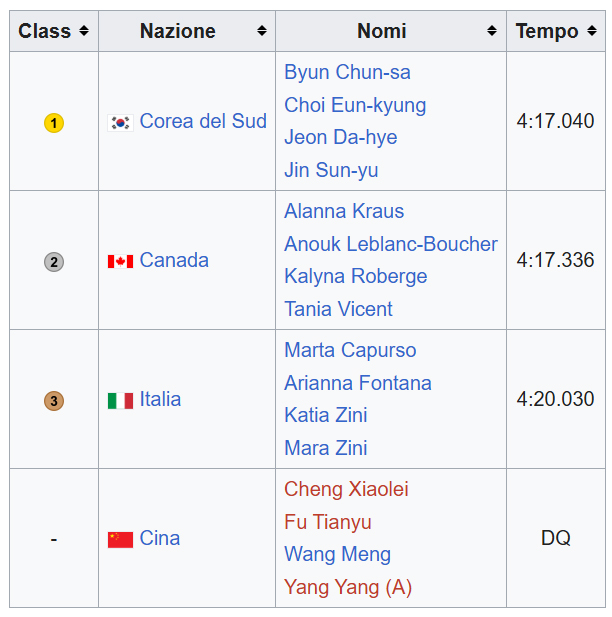
Staffetta 3000 metri femminile - Women's 3000-meter relay
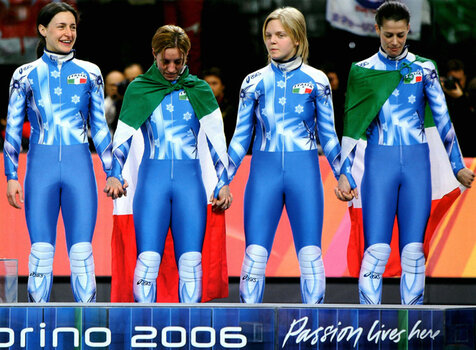
La medaglia n° 100 per l'Italia ai Giochi Invernali: da sinistra Katia Zini, Marta Capurso, Arianna Fontana e Mara Zini (dal Rapporto Ufficiale)

PATTINAGGIO DI VELOCITA'
SPEED SKATING
BOB
BOBSLEIGH
